


Getting to page one of Google used to be the obvious goal. It still matters. But now there’s another question worth asking: what happens when someone doesn’t click through a traditional search result at all?
They might ask ChatGPT for the best web design agencies in Perth. They might ask Gemini which accounting software suits a small Australian business. Or they could ask Perplexity to compare three products before they buy.
Try it with your own industry. Ask a few AI platforms to recommend businesses like yours. You may find competitors appearing again and again. You might also find companies you regularly outrank in Google getting mentioned while your brand is nowhere to be seen.
That’s where AI authority starts to matter.
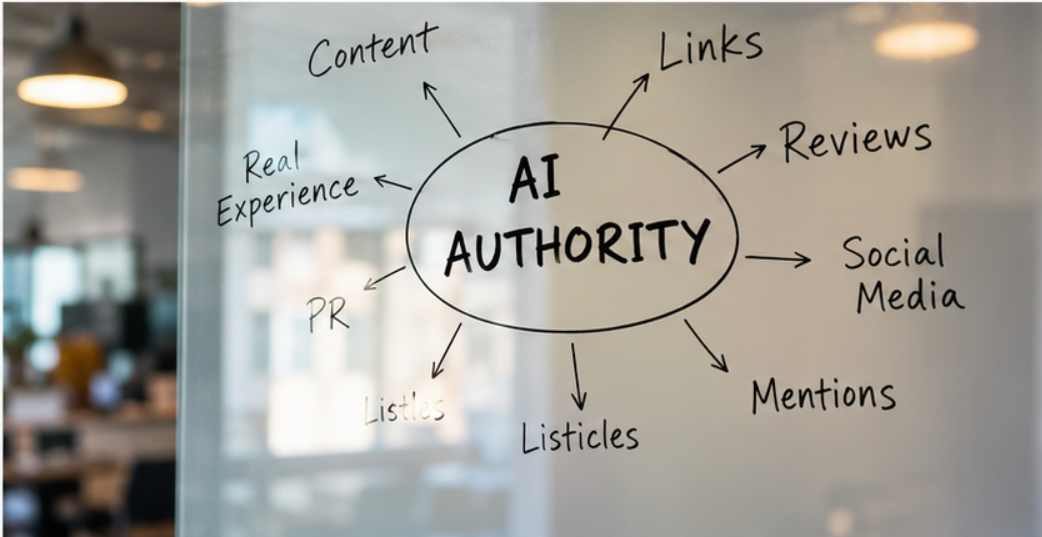
AI authority is about making your business easy for AI search systems to understand, verify and confidently mention when answering relevant questions. Your website still matters. Your SEO strategy matters. But what the rest of the web says about you is becoming increasingly important too.
AI Search Rankings Aren’t Really Rankings
This is where the terminology gets a little messy. People talk about “ranking in ChatGPT”, but there often isn’t a stable position one, two or three in the traditional SEO sense. Ask the same question differently, and you can get a different answer. Change the context, location or wording and different brands may appear. Different AI platforms can also use different sources.
So when we talk about AI search rankings, we’re really talking about visibility across a collection of relevant prompts. That changes how you measure success. Instead of obsessing over one position, start asking how often your brand appears, which questions trigger it, which competitors appear more frequently and which sources are influencing the answers.
Perhaps the most useful question is: why does an AI system have enough information to mention one business but not another?
Your Website Isn’t the Whole Story Anymore
For years, most SEO conversations started with your website. Fix the technical problems. Improve the service pages. Publish useful content. Strengthen internal linking. Earn backlinks. All of that still matters. A strong technical SEO foundation makes it easier for search engines to crawl, understand and index your content.
But AI search makes your off-site presence much harder to ignore. Your digital reputation is scattered around the web. Reviews. Articles. Interviews. Directories. Comparisons. Listicles. Reddit threads. Videos. Social posts. Industry publications.
AI search can bring those pieces together. This means the conversation is no longer just about what your website says about your business. What other people and websites say about you deserves attention too.
Why “Best X” Listicles Have Suddenly Become So Interesting
Here’s where things get particularly interesting. Ahrefs studied 26,283 source URLs used for recommendation-style searches and found that “best X” blog lists represented 43.8% of the page types appearing among ChatGPT sources.
It also found a relationship between brands appearing prominently across third-party lists and those brands being more likely to feature in AI responses.
Think about the question someone is asking. If the prompt is “What are the best SEO agencies for small businesses?”, a well-written article comparing ten SEO agencies is highly relevant source material. The article has already identified companies, categorised them and provided information that can be compared.
That doesn’t mean every listicle is valuable. Far from it. A thin “Top 10 Companies” article published on a poor-quality website doesn’t suddenly become valuable because someone added the words “AI search” to the sales pitch. Quality still matters. Relevance matters. The publication matters. Whether the page is indexed, maintained and genuinely useful matters too. You can read the Ahrefs research into “best” lists and AI recommendations here.
Listicle Link Building Is Already Becoming a Service
We’re already seeing link-building companies respond to this shift. LinksThatRank, for example, now offers listicle placements specifically around AI visibility. Its service creates new “best of” articles on third-party publisher websites and places the client’s business within the list.
The idea is interesting because a placement can potentially provide several things at once: a backlink, a brand mention, category context and exposure within a page that AI systems may retrieve.
That doesn’t mean buying a few listicles guarantees ChatGPT will start recommending you next Tuesday. Nobody can honestly promise that. But the strategy tells us something about where link building is heading. The old question was often: “Can we get this website to link to us?” The newer question is broader: “Can we get relevant third-party websites to talk about our brand in the right context?” That’s quite a meaningful difference. You can see the LinksThatRank listicle approach here.
Backlinks and Brand Mentions Aren’t the Same Thing
Backlinks haven’t suddenly become irrelevant. A strong link from a relevant, trusted website can help traditional organic visibility while also placing your brand inside content that AI systems may retrieve. But AI visibility makes the context surrounding the link more interesting.
Imagine two links. One sits halfway down an unrelated article with the anchor text “click here”. The other appears in an article called “10 Best Web Design Agencies in Perth”, where your company is described as a Perth web design agency specialising in custom WordPress websites, ecommerce and SEO.
Which one gives a machine more information about what your company actually does?
The second one. The link has value, but so does the surrounding language. Your brand name, category, services and location are being connected in one place. That’s why we need to stop treating every off-site mention purely as a link acquisition exercise.
What About Unlinked Brand Mentions?
An article doesn’t necessarily have to link to you to have some value. If credible websites repeatedly associate your company with a particular service or subject, those references contribute to the information available about your brand online.
Of course, we’d still prefer a good link when it’s appropriate. It can drive referral traffic, help people find you and support traditional SEO. But an unlinked mention isn’t automatically worthless. That distinction becomes more interesting as search moves from simply finding webpages to synthesising information about businesses, products and people.
Reviews Matter More Than Most Businesses Realise
Reviews have always influenced customers. AI makes them interesting for another reason: they’re third-party descriptions of what it’s actually like to deal with a business. Imagine a plumber with hundreds of reviews repeatedly mentioning emergency call-outs, fast response times, Perth, blocked drains and fair pricing.
Those reviews aren’t just star ratings. They’re pieces of contextual information connecting that business with particular services and customer experiences. The same applies to software reviews, agency reviews, ecommerce product reviews and professional services.
But there’s an obvious warning here. Don’t fake them. A genuine reputation becomes more useful when AI systems are trying to understand what people consistently say about a business. Fake reviews create the opposite kind of risk.
Reddit, Forums and Communities Deserve Attention
For years, businesses treated forums as something from the old internet. Then Reddit started appearing everywhere: Google results, AI answers, product research and recommendations.
People like communities because the answers often feel less polished and less commercial.
If someone asks, “What’s a good CRM for a five-person sales team that isn’t ridiculously complicated?”, they may trust another business owner’s experience more than a beautifully polished CRM landing page.
AI systems can draw on those conversations too.
That doesn’t mean your marketing team should storm into Reddit and start posting fake recommendations. People spot that stuff a mile away.
The better strategy is to become the sort of company customers genuinely talk about. Answer questions where appropriate. Have experts participate openly. Publish useful things people naturally reference. Give customers experiences worth discussing.
You can’t automate genuine reputation very well. That’s probably a good thing.
Create Content AI Systems Can Actually Cite
Your own content remains a major part of this. The question has changed slightly, though. Instead of asking only “Will this rank?”, ask “Would anyone actually use this as a source?” There’s a difference. A generic article explaining the same ten tips as everyone else isn’t particularly cite-worthy. Original information is.
Useful examples include:
- Original research
- Surveys
- Industry statistics
- First-hand testing
- Case studies
- Pricing data
- Experiments
- Expert commentary
- Detailed comparisons
- Useful tables and clear definitions
This is where a strong content marketing strategy starts to overlap with AI authority. The goal isn’t simply publishing more. It’s publishing something worth referencing.
A journalist writing an article needs evidence. If you’ve published the original data, they have a reason to reference you. The same principle becomes useful when AI systems retrieve sources.
Freshness Matters Too
Another interesting finding from Ahrefs’ research was how fresh many AI-cited lists were. Of the cited blog lists where a publication or update date could be identified, 79.1% had been published or updated during 2025 in the study.
That doesn’t mean changing “2025” to “2026” in your title and calling it a day. We’ve all landed on those articles.
“Updated for 2026!”
Then you read it and find screenshots from 2021.
Actual freshness means reviewing the information. Are the statistics current? Are the products still available? Has pricing changed? Are the recommendations still sensible? Are there new competitors? Have search behaviours changed?
Refreshing important content should involve making it genuinely better.
Traditional SEO Is Still Part of AI Authority
There’s been a rush to declare traditional SEO dead every time something new appears. Voice search was going to kill it. Social search was going to kill it. ChatGPT was going to kill it. And yet here we are, still optimising websites.
What has changed is the relationship between traditional rankings and AI visibility. Ahrefs reported in March 2026 that 37.1% of Google AI Overview citations in its study ranked in the traditional top 10 for the original query. Another 26.2% ranked between positions 11 and 100, while 36.7% were outside the top 100.
One explanation is query fan-out. Instead of retrieving sources only for the exact phrase someone typed, an AI search system can explore related sub-questions and retrieve sources from those searches too. So a page doesn’t necessarily need to rank for the exact original query to become useful to the final answer. What does this mean for you?
Don’t abandon your SEO strategy. Expand how you think about it. Technical SEO, crawlability, content quality, links, topical relevance and organic visibility remain useful foundations. Ranking one webpage for one keyword simply isn’t the whole game anymore.
Entity Clarity Sounds Complicated. It Isn’t.
“Entity optimisation” sounds like the sort of phrase invented to make SEO seem more mysterious than it needs to be.
The practical idea is simple. Make it easy to understand who you are, what you do and where you fit. If your website uses one version of your company name, LinkedIn uses another and old directories describe services you stopped offering three years ago, you’re creating unnecessary ambiguity.
Keep the basics consistent. Your company name. Location. Services. People. Expertise. Contact information. Social profiles. Important business relationships. Use appropriate structured data where it helps search engines interpret the information.
More importantly, make sure humans can understand it too. If someone lands on your website and can’t tell what you do within ten seconds, schema probably isn’t the biggest problem.
Build Third-Party Proof
Your own website should make your case. The wider web should help confirm it.
That could mean:
- Earning placements in credible industry listicles
- Securing genuine editorial reviews
- Contributing expert commentary
- Running digital PR campaigns
- Appearing on podcasts and YouTube channels
- Being included in relevant directories
- Earning genuine customer reviews
- Getting cited for original research
- Building relevant editorial links
- Participating appropriately in industry communities
Relevant backlinks still belong here too. A thoughtful link-building campaign can support traditional search authority while also increasing the number of credible places where your business is discussed.
You don’t need to do everything at once.
You do need to stop thinking that publishing another blog post on your own site is always the answer. Sometimes the content that strengthens your authority most isn’t published on your domain.
Create Something People Need to Reference
This is one of the strongest opportunities because it creates genuine value. Find a question in your industry where everyone quotes the same stale statistics. Then research it properly.
If you’re an ecommerce agency, analyse checkout experiences across 100 Australian stores. If you’re an SEO company, study how Australian businesses appear in AI search. If you’re a recruiter, publish salary data. If you’re in construction, analyse building costs.
Now you have something other people actually need. Journalists can cite it. Bloggers can reference it. People can share it. Other websites can link to it. AI search has an original source it can potentially retrieve. That’s authority worth building.
A Practical 90-Day AI Authority Plan
Month 1: Find the Gaps
Run 20 to 50 important prompts across the AI platforms that matter to your customers. Record brand mentions, competitors and cited sources.
Audit your brand presence across review sites, directories, social profiles and important third-party mentions. Look for inconsistent descriptions, missing information and obvious gaps.
Then identify the pages and publications AI systems are already citing in your category. You’ll probably discover opportunities you weren’t looking for before.
Month 2: Strengthen the Footprint
Start earning relevant third-party mentions. Pitch credible listicles where your inclusion makes sense. Pursue editorial reviews and industry coverage. Improve weak directory profiles and encourage genuine customers to leave reviews.
At the same time, update your strongest website content. Don’t publish twenty mediocre articles. Improve the pages that genuinely deserve to be referenced.
Month 3: Create Something Worth Citing
Publish one substantial asset. It could be original research, statistics, a useful tool, a benchmark or a detailed case study.
Promote it properly. Share it through social channels. Send it to relevant journalists and publishers. Put it in front of industry communities where it’s genuinely useful. Then rerun your original AI prompts and compare what changed.
Can You Guarantee AI Rankings?
No. Be very wary of anyone who says they can.
There isn’t a button agencies can press to make ChatGPT recommend a particular company. AI responses change. Models change. Retrieval systems change. Sources change. Prompts change.
What you can do is improve the information environment around your business.
You can make your website easier to understand. You can earn stronger third-party mentions. You can create original material worth citing. You can build a real reputation. You can appear in the publications and conversations relevant to your market.
And you can measure whether those efforts are increasing your visibility.
That’s a much more realistic way to approach AI search.
What This Means for Your Business
AI authority isn’t some completely new branch of marketing where everything we’ve learned about SEO suddenly gets thrown away. A lot of the fundamentals look surprisingly familiar.
Build a good business. Have a technically sound website. Publish useful information. Earn relevant links. Get customers talking about you. Build relationships with credible publications. Create things worth referencing. Keep your brand consistent.
The difference is that we’re no longer doing those things solely to move a blue link higher up Google. We’re building a digital footprint that machines can interpret too. That’s why listicles, reviews, Reddit discussions, social visibility, digital PR and third-party mentions are becoming much more interesting. Your website can tell AI what you do. The rest of the internet helps confirm whether anyone else believes you.
Want to Build Your AI Search Visibility?
If your business already invests in SEO, you’re probably closer than you think.
The first step isn’t abandoning your existing strategy for the latest acronym. It’s understanding where your brand currently appears, where competitors are being recommended instead and which sources are shaping those answers. From there, you can strengthen your SEO, content, link building and wider digital presence around the gaps that actually matter. Because the goal isn’t simply to “rank in ChatGPT”. It’s to become one of the businesses people, and the systems helping them make decisions, keep finding when it matters.
If you’d like help working out where your business stands, talk to the Lilo team.
Final Thoughts
Search isn’t disappearing. It’s spreading out. People still use Google. Now they also research products in ChatGPT, compare businesses through Gemini, check sources in Perplexity, read Reddit threads and encounter AI-generated answers directly inside search results.
That changes what authority looks like. Ranking your own website still matters. But increasingly, you also want other credible places on the web talking about you for the right reasons. That’s AI authority in practical terms.
Not tricking an algorithm. Not stuffing “AI-friendly” phrases into your pages. Just making your expertise easier to find, easier to verify, and easier to trust. And, strangely enough, that’s probably where good SEO was heading all along.


Does Social Media Help AI Search Rankings?
This needs a bit of care because it’s very easy to oversell. There isn’t good evidence that getting 200 LinkedIn likes suddenly pushes you five positions higher in ChatGPT. AI search doesn’t work that neatly.
Social media is useful because it expands the footprint around your brand. It creates conversations. It spreads research and content. It can lead to branded searches, links, discussions and mentions elsewhere.
Public social content may also become source material depending on the platform and AI system involved. Reddit is particularly interesting because people discuss products and businesses in natural language. They don’t usually write carefully optimised marketing copy. They talk about what worked, what didn’t and what they’d recommend to someone else.
That kind of conversation creates context that can be difficult to manufacture convincingly on your own website. So yes, social visibility can form part of AI authority. Just don’t reduce that to “social shares are an AI ranking factor”. We don’t have good evidence to make that claim.